Contact
info@wonsa.org
Address
Anders Reimers väg 18
117 50 Stockholm
Contact
info@wonsa.org
Address
Anders Reimers väg 18
117 50 Stockholm

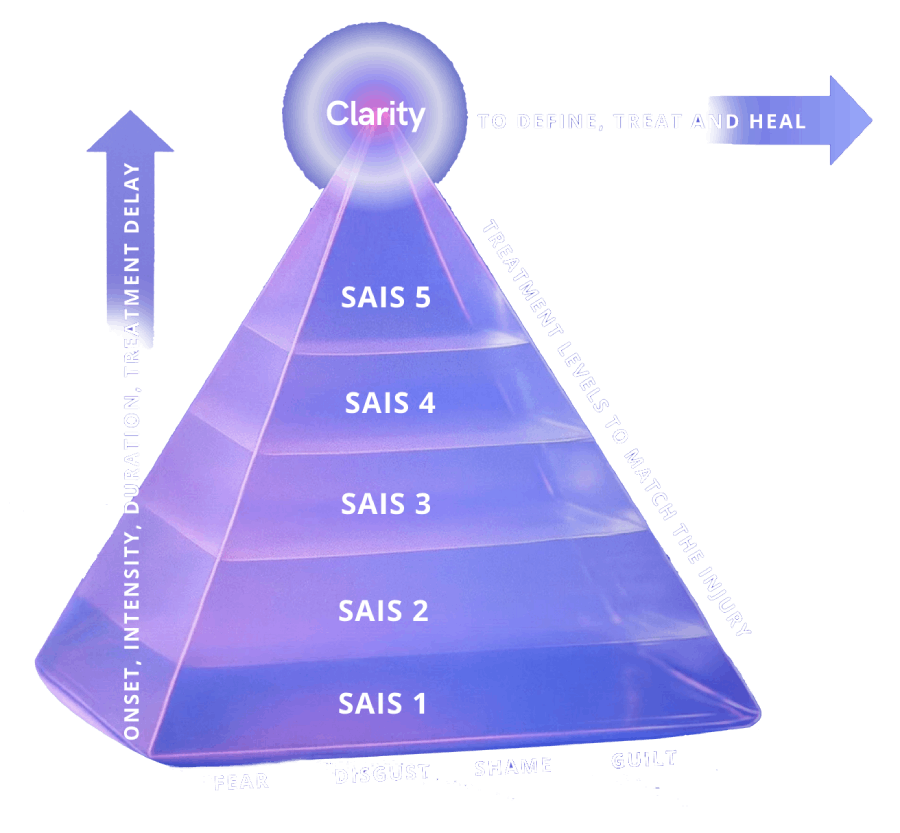
The impact of sexual abuse on the brain, body, and sense of self is real, specific — but often widely unrecognized across healthcare. Survivors are too often mistreated or misdiagnosed. They deserve the same systematic, knowledge-based care found in other areas of medicine. SAIS drives that shift.
Be part of the shift.
For a better world, free from sexual abuse.
Developed together with survivors over through more than 10 years of research and practice, SAIS is an injury-based approach moving beyond symptoms to identify the patterns of injury that shape a person's ability to heal, and defining treatment principles to meet them. When those patterns are recognized, care becomes safer, more precise and effective.
Whether you are a survivor seeking to understand your own experience or a professional bringing this knowledge into clinical practice — SAIS offers a way forward. Be part of the shift.

Sexual violence exists in every part of society — in families, relationships, institutions, and organised settings. While many still look away, survivors carry these experiences with them. These experiences are a source of knowledge and a force for change. At WONSA, we have listened to survivors for over a decade, weaving their experiences into clinical research. SAIS is the result of this work.
This is where change begins.
ACEs
ACEs (Adverse Childhood Experiences) refer to ten types of childhood adversity that are strongly associated with psychiatric and physical health outcomes later in life. ACEs originates from a large U.S. study in the 1990s, highlighting how abusive, neglective or dysfunctional family environments affect neurobiological development and identity formation.
These experiences create a background that modifies the effect of sexual abuse, influencing the trajectory and severity of injury development.
The original ten ACEs are experiences occurring before the age of 18, including: physical, emotional, and sexual abuse; physical and emotional neglect; witnessing domestic violence; growing up with a parent affected by mental illness or substance abuse; having a family member in prison; and parental separation or divorce.
SAIS
SAIS (Sexual Abuse Injury Syndrome) is a syndrome developed by WONSA, describing common patterns of symptoms and diagnoses — including PTSD, CPTSD, and DID — across a full continuum of injury following sexual abuse. Our framework is built around this syndrome, proposing core injuries underlying each level and treatment principles to meet them.
SAIS also enables risk stratification — assessing the likelihood of different injury levels based on a person's experiences. Two factors shape this picture: adverse experiences earlier in life (ACEs) and the factors set out in our Sexual Abuse Classification (SAC), which spans the full range of sexual abuse — from repeated harassment and single rapes, through repeated childhood sexual abuse, to organised ritual abuse and mind control of the kind documented in the Epstein and MKUltra files. This kind of assessment matters because the symptoms of sexual trauma may shift from day to day, clouding the picture — the factors shaping the risk of injury do not.
Through ACEs and SAC, the SAIS framework provides a structured and systematic way of working — making evaluation and research possible, and enabling care that is both targeted and effective.
Sexual Abuse Injury Syndrome
Developed by WONSA.
Sexual Abuse Classification
A part of WONSAs framework
SAC
At WONSA, we believe it should be possible to describe sexual abuse without relying on legal language — terms that were never designed for clinical use and may inadvertently imply involvement or responsibility.
That is why we developed SAC (Sexual Abuse Classification). SAC provides a shared clinical language for identifying and communicating types of sexual violence and key contextual factors — precisely and consistently, without requiring survivors to recount traumatic events in detail. For clinicians and researchers, SAC enables clearer assessment and documentation.
For us, compassion is a responsibility — to consistently choose approaches that are both effective and gentle, for those seeking treatment and for those providing it. It requires discernment: recognising the distinct benefits and challenges of symptom management and healing, and knowing when each serves the person best. It is a commitment to follow the injury to its source not stopping short of the root cause when healing is possible. That is why we go beyond symptoms and stand firmly in an injury perspective.
It is the underlying principles of injury and healing that guide our work — not adherence to any single approach or method.
When the principles are understood, a broad toolbox of methods becomes available, each adapted to the person and situation at hand. This gives us freedom and flexibility — making care truly person centered.
Remembrance matters
Dissociation is one of the most powerful protective mechanisms available to the human mind. But what protects in the moment can obscure over time — leaving a person disconnected from the thread of their own life. Remembering may be painful. Yet without access to one's own history, it is difficult to fully own one's life — or take responsibility for one's future. Offering the safety and space for people to reclaim their life-histories, and bearing witness to what has taken place, is essential to healing. This matters not only for the individual — but for their families, for society, and for generations to come.
Read more about the wars on memory below.